Primeria: A Board Game about Prime Numbers
Table of Contents
Hi, I want to share with you a board game I invented yesterday. It is a two-player board game which combines clever strategies with quick mental arithmetic skills. I have here an interactive UI which you can try out.
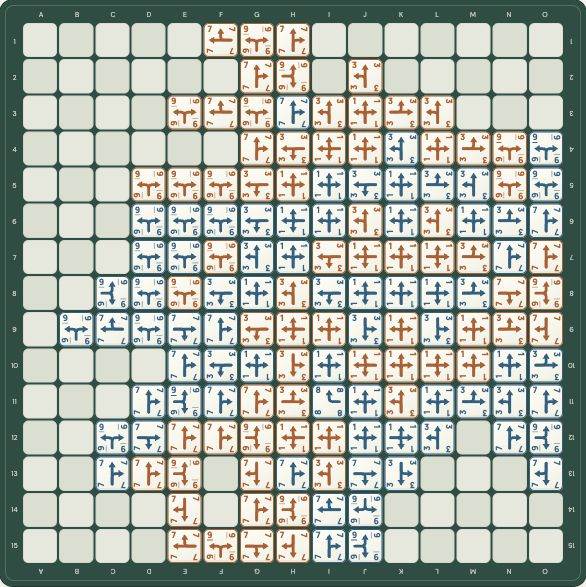
These are the current rules.
Setup
Play on a 15 × 15 board. Each player has 162 tiles: 18 copies of each digit from 1 to 9, marked in their colour. Both players’ reserves are visible.
| Tile | Digit(s) | Arrow | Copies per digit |
|---|---|---|---|
| Regular | 4, 5, 6 | Straight | 18 |
| Regular | 2 | Bend left | 18 |
| Regular | 8 | Bend right | 18 |
| Junction | 1 | Straight + left + right | 18 |
| Junction | 3 | Straight + left | 18 |
| Junction | 7 | Straight + right | 18 |
| Junction | 9 | Left + right | 18 |
Moves
Flip a coin to decide who goes first. Players take turns. Before your move, you may attempt one Challenge. Then Drop or Pass.
Note: Two of your tiles are connected if they share an edge and their arrows connect. A path is a sequence of at least two of your tiles connected in the direction of the arrows. A cycle is a path whose last tile connects back to its first. A segment is a path whose first and last tiles are junction tiles. A group consists of your tiles connected through matching arrows, in either direction.
Drop. Place one of your unused tiles on an empty square, choosing its arrow orientation. A Drop is illegal if it creates a cycle. Tiles cannot be rotated after placement.
Pass. End your turn without placing a tile.
Challenge. Choose an opponent’s segment and read its number from the last tile to the first, against the arrows. Propose a positive integer factor greater than 1 and smaller than the number, then verify it with a calculator. If correct, remove all tiles in the segment and keep them as captures. Captured tiles stay out of play. Whether correct or not, then make your Drop or Pass.
Note: On a virtual board, factor verification is automatic.
Endgame
Two consecutive passes end the game. A successful Challenge breaks the pass streak; a turn with a successful Challenge does not count as a pass.
First, remove all regular tiles that do not lie on a segment. Then remove all tiles in groups of fewer than six. Give each removed tile to its owner’s opponent as a capture.
Score one point for each of your tiles left on the board and each captured tile. Empty squares do not score. The higher score wins; equal scores are a draw.
A player also loses by resigning or running out of time.
Time Controls
Choose a time control before starting.
| Mode | Starting time per player | Increment per completed turn |
|---|---|---|
| Blitz | 10 minutes | 10 seconds |
| Rapid | 20 minutes | 20 seconds |
| Standard | 30 minutes | 30 seconds |
| Classical | 45 minutes | 60 seconds |
| Casual | No clock | — |
Your clock runs throughout your turn, including factor verification and removing captured tiles. Add the increment once, after your Drop or Pass.
Tips
These divisibility tests can help you find factors:
-
A number is divisible by 2 if and only if its last digit is even.
-
A number is divisible by 5 if and only if its last digit is 0 or 5.
-
A number is divisible by 3 if and only if the sum of its digits is divisible by 3.
-
A number is divisible by 7 if and only if subtracting three times its last two digits from the remaining number gives a multiple of 7.
-
Alternately add and subtract the digits of the number. The number is divisible by 11 if and only if the result is divisible by 11.
-
A number is divisible by 13 if and only if subtracting nine times its last digit from the remaining number gives a multiple of 13.
-
Split the number into groups of three digits from the right, then alternately add and subtract the groups. The original number is divisible by 7 if and only if the result is divisible by 7. The same test works for 11 and 13.